
I Can See You
An appreciation of Grant Morrison's "Animal Man" funnybook


As you all have seen endlessly in this space, I was a big comic collector from a very early age. Every week, I'd walk to my local Stop-N-Go, or the nearby 7-11, and drop every last penny of my hard-earned allowance down for funnybooks. It only got worse when I became a teenager, and had part-time jobs that allowed me to spend even more coin, and when a comic book store, “All About Books & Comics II,” opened up less than a mile away from my house, it was like a fentanyl dealer setting up shop outside a middle school. My mom once asked how much money I spent a week on comics, and was horrified when I answered ten or twenny dollars.
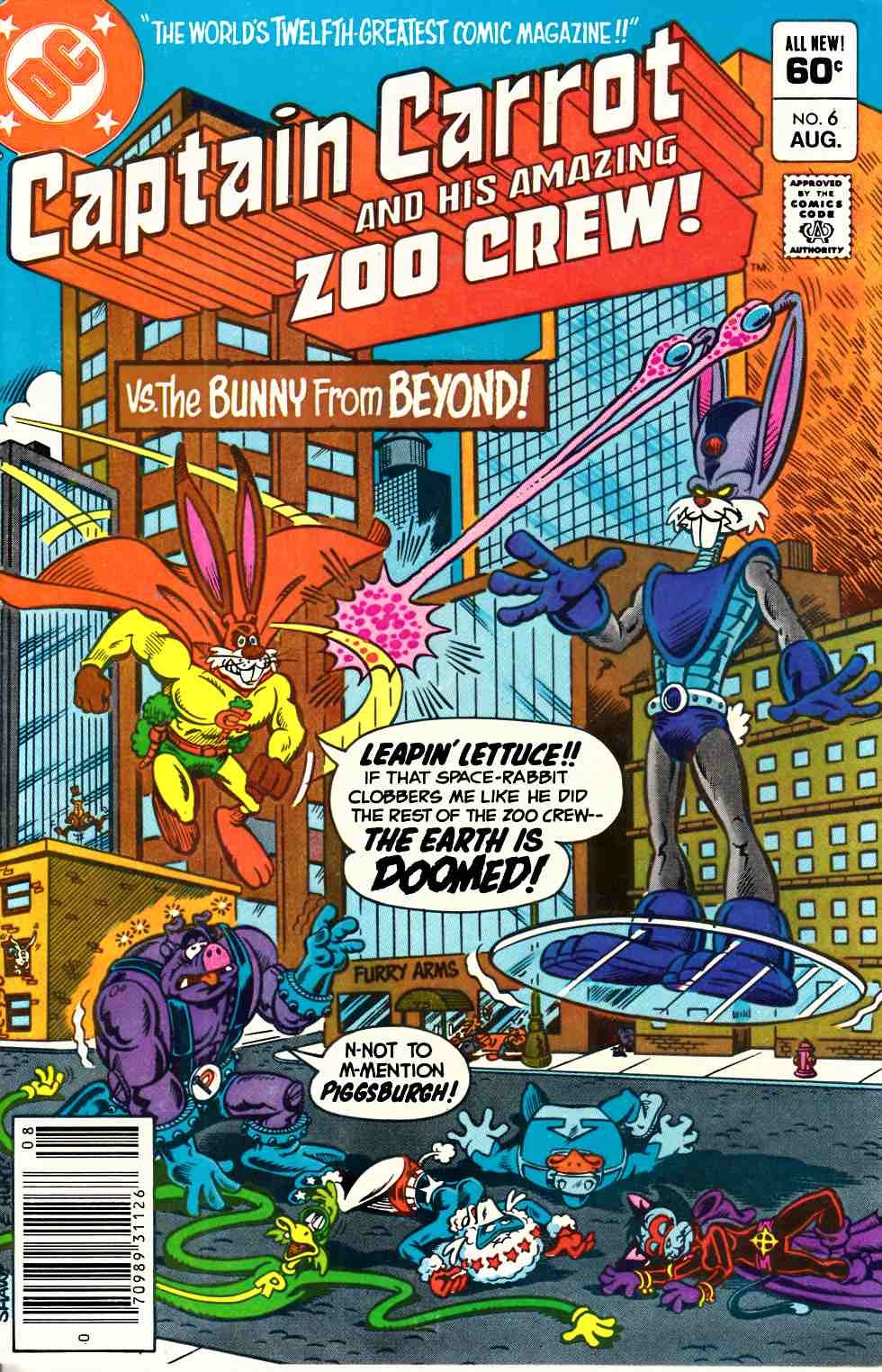
(I know, some books these days cost twenny on their own, but back then, you could fill your gas tank for that kinda ducats. Or buy lots of comic books.)
Anyway, this allowed me to read a great number of funnybooks every month, so in addition to my beloved X-Men comics, I could experiment with indie books, or buy stuff from creators I'd never heard of.
Which brings us to Animal Man.
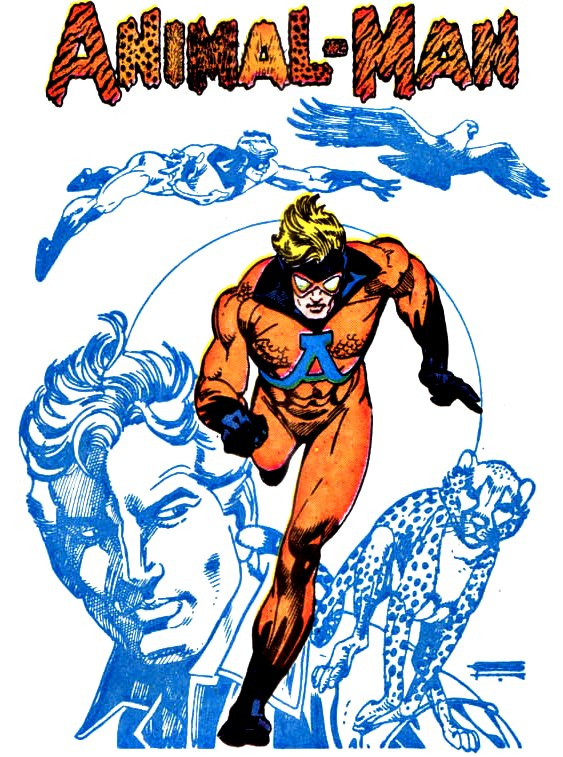
Dumbest name in the world for a hero, right?
I'd seen him once before, in an issue of "Action Comics," when he was clubbed up with a supergroup called "The Forgotten Heroes."
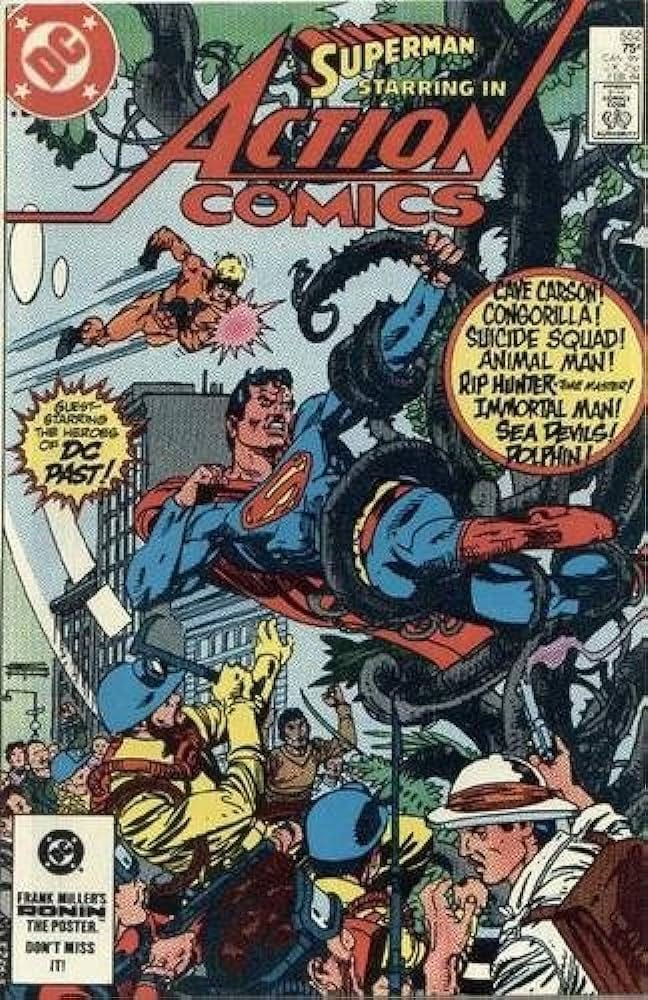
Forgotten for a reason, amiright? Yuk yuk yuk.
Anyway, this incredibly creative superhero had the amazing ability to... get this... duplicate the abilities of any nearby animal. So, if a fly was around, he could reach out and snag the abilities of flight, seeing in all directions, and maybe eating poop and spitting corrosive fluid, I don't know. Did he grow wings? No, he just sorta... flew. How? MAGIC, YOU LOUSY NON-BELIEVERS, JESUS, DO I HAVE TO EXPLAIN EVERYTHING AROUND HERE?!?!
Yes, he was a dumb superhero. Far as I'm aware, he'd never been given his own comic before. For good, good reason. He was one of the bazillions of generic heroes cranked out in the 50s, probably just so DC could trademark the name. Which, y'know, given that it's so daring and original, how could you not race to snap that one up?
(Though, I just looked it up and learned that his original name was "A-Man," which, I'm not sure is much better, but it at least sounds a little less stupid. Somebody disagreed though, and he was only A-Man the oncest.)
And yet, in the 80s, somebody was willing to give a shot to an "Animal Man" comic book.
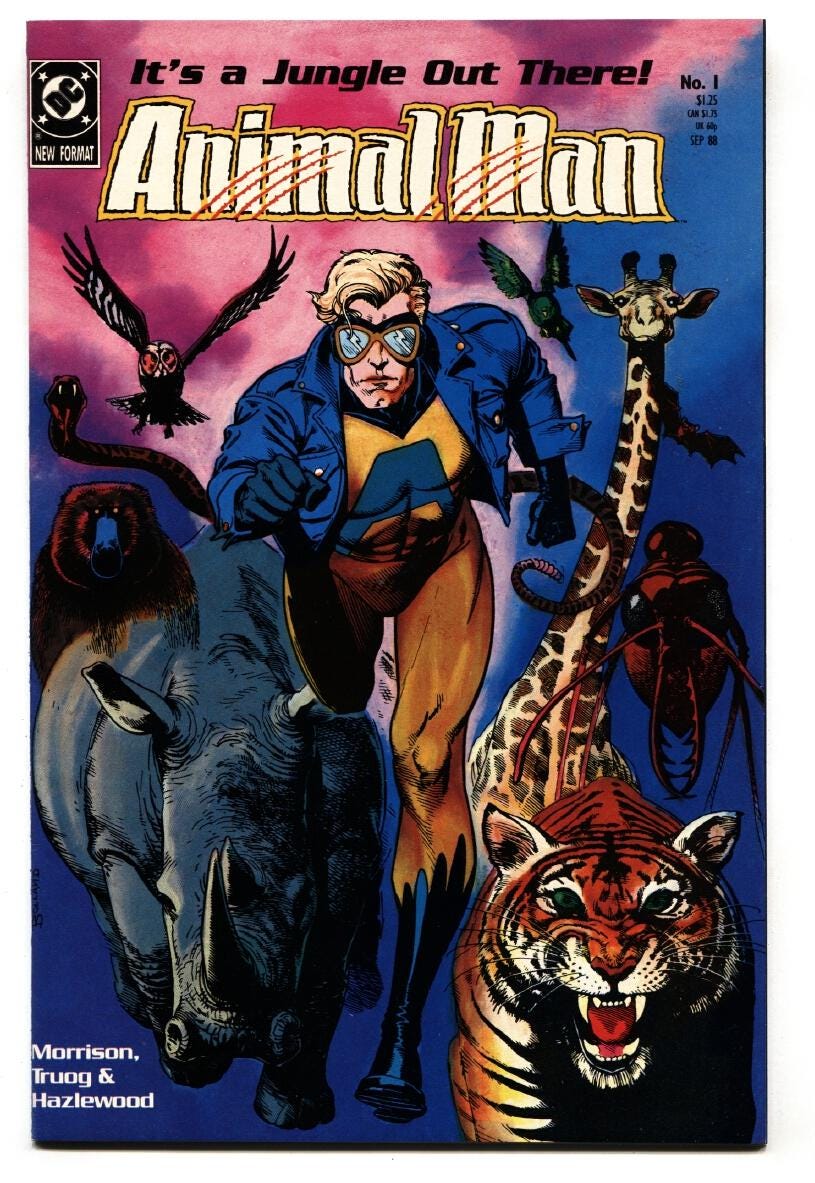
I had never heard of writer Grant Morrison or artist Chas Truog before I picked up that first issue. I remembered the hero from that Superman comic, and little else. I don't honestly know what I expected from the book, though I may have been influenced by the great cover by Brian Bolland. He did all the covers for "Animal Man" for years, and if you ask me, he deserves a big check, or an Eisner, or a hug or something, because those covers were spectacular. And probably a better sales gimmick than using Truog's art. I'm not saying one or the other is better, but they could not be more different. Bolland is a precursor to Alex Ross, and the photo-realistic approach to superheroes. His figures look as close to real as you got in those days without actually just using a photo. Truog's style was much, much looser, simpler, almost cartoony. Much as I enjoyed it, I don't see the style inside the book selling it better than the paintings that they used.
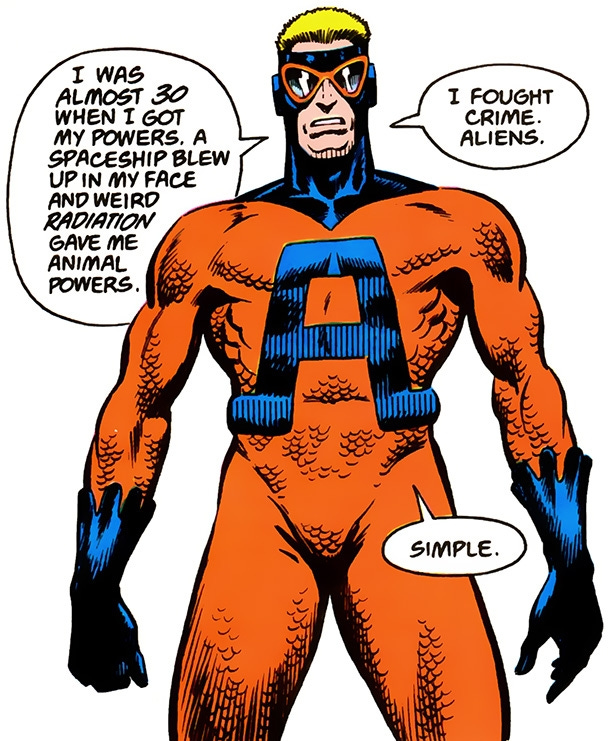
So what was the book about? Well, it was about Animal Man, who, in his not-so-secret identity of Buddy Baker, movie stuntman, fights for truth, justice, and to try and get paid. He had a family to support, y'see, a wife, a son and a daughter, and while he'd tried a number of different things, he was just sort of a goof, looking for direction. And that, right there, was the beginning of one of the more interesting comic characters of the 80s for me. He reminded me of a grown-up Peter Parker, trying to figure out how to pay the bills, and how superheroing fits into the rest of his life.
Plus, he's also kind of a flake. He wife, Ellen, is supportive of his dreams, but also tries to nudge him towards something, anything. The series begins with Buddy deciding to try and make a go of this superhero thing one more time, and with Ellen wearily trying to get behind it. That was already one of the strengths of the book, the family characters were equally as fleshed out as the main character, which is incredibly freakin' rare in comics. His kids were equal parts cute and annoying. His best friend was more useless than he was. His neighbors were curmudgeons. I would read the book as much for the other characters as for him.
And the book was interesting. This Grant Morrison kid had some clever ideas, mostly involving Buddy becoming more aware of the atrocities committed against animals by humankind. He became a vegetarian, forcing his family to do the same, to his kids' chagrin. He started doing less superheroics, and more saving the environment-type stuff. Which, in those days, was not the way you sell a superhero book.
And, best of all, Morrison seemed to be trying to show an average guy, and how he fits into this world of gods, monsters, villains and demons. He meets Superman in a brief moment, shakes hands with him, and comments that "his arm feels like glass" in Superman's hand. This to me was an amazing bit of characterization, showing what a mere mortal would feel like, doing something as mundane as shaking hands with Superman. It was also a great bit of foreshadowing, as a few pages later, that very same arm gets chopped off.
That was the end of the first issue, and I was like, well, that's bold, at least. Not sure what he's gonna do with only one arm for the rest of the series. But that's where Morrison was clever, because in the very next issue, in the first pages, as Buddy is hemorrhaging blood and dying, his powers kick in, and latch onto the worms in the ground, and worms... can regenerate. And moments later, he has a new arm.
And it terrifies him.
There's plenty of great stuff that happens in this series, and through it all, Buddy continues to be mostly perplexed and feel very small in the grand scheme of things. At one point, he comments that he doesn't even feel like the main character in his own story, an off-hand comment that'll come to mean a great deal in later issues. There are plenty of great ideas, fun stories, and interesting notions about the nature of comic books that Morrison would ultimately execute in his couple years on the book, too many to name, and I was there every month to watch it all.
But I almost wasn't.
Back in those days, I could be pretty fair weather about my comic purchases. I would religiously collect a book, then either miss an issue, or get bored with it, and drop it like a hot potato. X-Men was the only thing I mostly stayed on top of, and I even quit that one for a little while, when things got a little too weird for my taste (for X-Men fans, this would be the Australia years. Yeah, you know what I'm talking about).
So, there came a point when I'd been enjoying "Animal Man," but there were a few months when it seemed like the book was veering in a different direction. Buddy had kinda gotten his act together, joined the big guns in the Justice League, and things seemed to be going okay for him. And while the book was good, I feared that it was going to end up like most other comics, fighting villains, things go in circles, blah blah blah.
I remember distinctly, I'd picked up my subscriptions at the comic book shop, and was sorting through them, including the latest "Animal Man." They asked that you buy everything they set aside for you, fair enough, so I was stuck buying this one, but I was trying to decide if I was gonna cancel my subscription. I leafed through the latest issue in the store, to see if the story was threatening to go anywhere interesting.
(For those of you who know the series, it was #19, titled "A New Science of Life." You know where I'm going with this. Those who don't know what I'm talking about, spoilers for a thirty-year-old funnybook.)
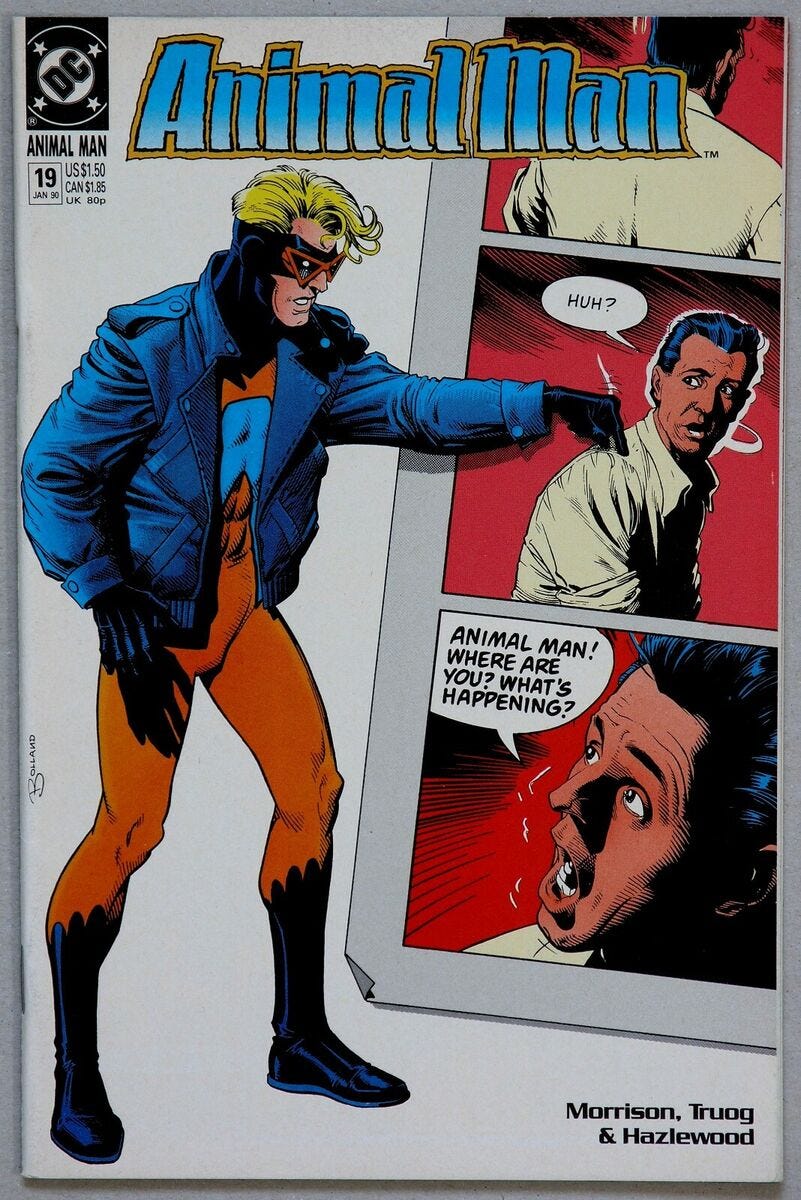
It was a continuation of the previous issue, where Buddy had gone on a vision quest to explore his powers and where they came from.
I... tend to dislike those kinds of stories. I don't know why, but when characters go to the desert and take peyote in movies and stuff, I just kinda tune out. I'm a practical type'a fella, so maybe the spiritually just doesn't mesh with my understanding of the world. I'm sure my therapist can tell you plenty.
But whatever the reason, I'm reading about Buddy having his hallucinogenic experience, he's tripping balls, I'm bored, I'm about to tell the shop owner he can just go ahead and take this book off my pull list. And then I turn the page...
... and got damn if there isn't a full splash page, where Buddy Baker breaks the fourth wall, looks directly out of the comic, and says, "I can see you!"
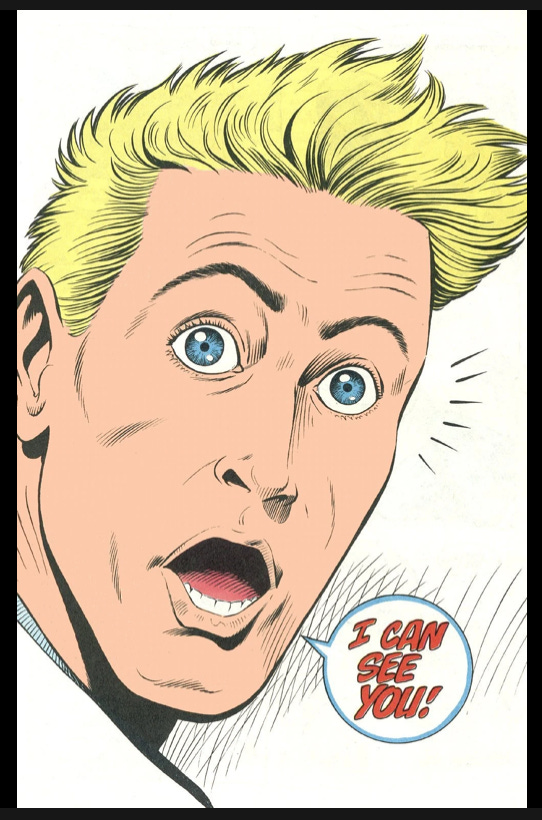
Meaning you, the reader. He's just realized he's a comic book character.
Now, plenty of characters have discovered they're in a comic, or movie, or TV show. Deadpool's whole schtick has become wrapped around the fact that he knows he's in a comic book. Or movie, or video game, whatever's going on.
But here's the thing: those stories are nearly always humorous. And in the context of the actual characters, those realizations are treated more or less as insanity. The character talks to the audience, somebody says, "who you talkin' to?" and the characters says, "Oh, nobody!" Laughs ensue. And the relationship of reader and character is kinda broken, so the story can continue.
This was the first time I'd ever seen that device used in a grim & gritty comic book, and made you consider the horrific consequences of what it means.
I put it in the stack, kept my subscription, and was treated to a story the likes of which are rarely seen in comics. I discovered that the boredom I'd had with the previous issues of the book was by design. Morrison seemed to be lulling the audience into a false sense of security, so as to more properly yank the rug out from under us, and Buddy. Things would get drastic in the issues to follow. It's a heartbreaking book, and I'm glad I stuck with it. It's one of my favorite runs on any comic, period.
As it turns out, Morrison only stayed with the book to finish that story, and within six months, he was gone. The book continued without him, and it's definitely interesting, as various writers try to figure how to pick up the pieces of this character who's discovered his ultimate truth, and how do you just have him go back to fighting bozo villains after that?
Buddy Baker has been a difficult character ever since, and most creators settle on torturing him and his family, trying to make him discover yet another uncomfortable truth about himself, and some of stories are good, but it's just not the same. I mean, that's a hard trick to pull off twice, take a character nobody gave a shit about, and propel him to the status of Important Character in less than two years. Especially when the whole conceit of the character is that he's a generic superhero, looking for purpose.
Damn, too real man, too close to home, now I need to read some Batman and imagine myself getting armored up and beating the snot outta mentally unstable villains playing dress-up.
Text © 2024